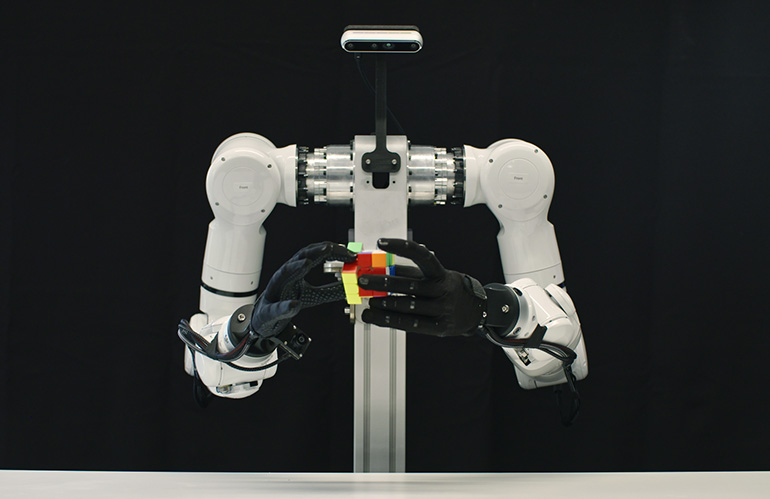
Teaching Robots to Use Their Hands
For decades, robots have been exceptional at repetitive, structured tasks — welding the same joint on an assembly line, picking the same box from the same shelf. What they have struggled with is the kind of dexterous, adaptive manipulation that humans do without thinking: opening a jar, folding a shirt, assembling a circuit board with irregular components.
Genesis AI is trying to close that gap. On May 7, 2026, the company unveiled GENE-26.5 — a robotics foundation model designed to give robots human-level physical manipulation capabilities — alongside a proprietary robotic hand and a glove-based data collection system.
How GENE-26.5 Works
The core insight behind GENE-26.5 is that the best way to teach a robot to manipulate objects is to learn directly from human hands. Genesis AI built a data collection system using an instrumented glove that captures the precise movements, forces, and contact patterns of a human hand performing a task.
That data is used to train GENE-26.5, which can then generalize the learned behavior to a robotic hand in a variety of environments and object configurations. The model does not just replay recorded motions — it understands the underlying physics and intent, allowing it to adapt when objects are in slightly different positions or orientations.
The accompanying simulation platform allows developers to test and refine robot behaviors in virtual environments before deploying to physical hardware — addressing what the industry calls the sim-to-real gap.
Why This Matters
Manipulation has been the hardest unsolved problem in robotics. Locomotion — walking, running, navigating — has seen enormous progress over the past decade. But manipulation requires a different kind of intelligence: understanding contact, force, deformation, and the physical properties of objects.
GENE-26.5 represents a meaningful step toward robots that can work in unstructured environments — not just factories with perfectly positioned parts, but warehouses, hospitals, kitchens, and construction sites where the world does not cooperate.
The Data Infrastructure Behind Physical AI
What often goes unnoticed in robotics announcements is the data infrastructure required to make these systems work. Training a foundation model like GENE-26.5 requires massive amounts of structured, time-series data — sensor readings, joint positions, force measurements, camera feeds — all synchronized and stored at high frequency.
Deploying that model in production requires real-time data pipelines, low-latency storage, and the ability to log and replay robot behavior for debugging and improvement.
This is exactly the kind of infrastructure that CredVault is built for. Our platform handles real-time telemetry from robotic systems, stores multimodal sensor data, and provides the visualization tools needed to understand what a robot is doing and why. As foundation models like GENE-26.5 move from research to production, the data infrastructure layer becomes critical.
What Comes Next
Genesis AI's announcement is part of a broader wave of robotics foundation models emerging in 2026. Nvidia, Google DeepMind, Physical Intelligence, and now Genesis AI are all racing to build the general-purpose intelligence layer for physical robots.
The companies that win this race will not just be the ones with the best models. They will be the ones with the best data infrastructure — the ability to collect, store, process, and learn from the enormous volumes of physical world data that robots generate.